I hear it from prospects, never from clients: “We’re in a great location. We don’t need to advertise.” The restaurant is on the busy corner, the store is in the right plaza, the neighborhood is full of exactly the customers they want. Why spend on ads, social media or radio? Over the years I’ve watched more than a few of those owners close within months of saying it. The logic sounds reasonable. It is wrong, and the numbers show why.
The neighborhood you think you own is moving away
A location only works if the people around it know you. The problem is that the people around it keep changing. Census estimates for the year ending July 2024 show Miami-Dade gained 64,211 residents, the second-largest increase of any county in the country. Broward grew 1.7% and Palm Beach 1.6%, both faster than the nation.
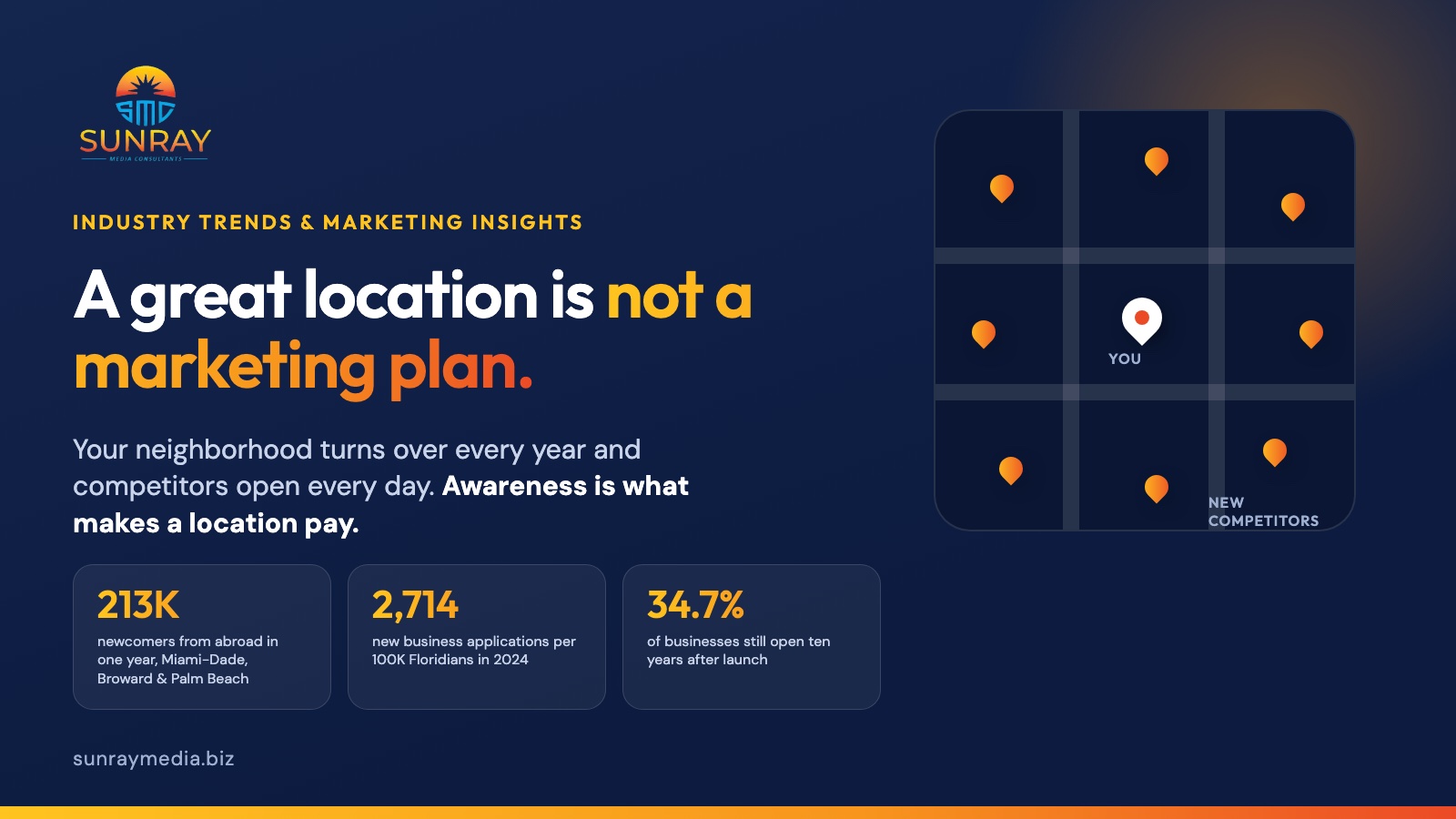
Underneath those totals is a churn most owners never see. In that one year Miami-Dade lost 67,418 residents to other parts of the country and gained 123,835 from abroad. Broward lost 26,339 and gained 56,567. Palm Beach lost 7,546 and gained 32,825. Across the three counties, more than 213,000 newcomers arrived from outside the country in twelve months, and about 100,000 people left. Your regulars are being replaced whether you notice or not, and the new neighbors have never heard of you.
New competitors open every day
Florida filed 2,714 new business applications for every 100,000 residents in 2024, the third-highest rate in the nation according to Census Business Formation data, and led the country in new business formations in 2025. At that rate, a county the size of Broward sees more than 50,000 new business applications a year. Some of them are the restaurant two doors down and the showroom across the street, opening with a grand-opening budget and a fresh story while you rely on the sign.
Most of them won’t last, and the location doesn’t decide which
The Bureau of Labor Statistics tracked every private-sector business opened in March 2013. Ten years later, 34.7% were still operating. The steepest drop came in the first year, when the survival rate fell 20.4 points. The ones that closed had locations too. A good address is table stakes. What separates the survivors is whether the market knows them and chooses them.
Being there is not the same as being chosen
Customers decide before they see your storefront. Google’s research found that 76% of people who search for something nearby on their phone visit a related business within a day, and 28% of those searches end in a purchase. The search happens in the car, on the couch, in the parking lot. If a competitor owns the reviews, the videos and the name people recognize, they get the visit, and your prime corner becomes the place customers drive past on the way there.
And awareness is perishable. Nielsen’s Compass data shows a brand loses 2% of future revenue for every quarter it doesn’t advertise, and recovering from an extended stretch off air takes three to five years of consistent brand building. A location you stopped promoting is a location the market is quietly forgetting.
What the owners who last do differently
- They treat new residents as new customers. Consistent presence on TV and streaming at home, radio in the car and social media every week, so the family that moved in last month learns the name this month.
- They are easy to find before the drive. An accurate Google Business Profile, fresh photos, answered reviews and a website that makes the visit easy.
- They tell a story, not just an address. Video of the food, the work, the people. A location says where you are. A story says why to come.
- They measure. Calls, website traffic, foot traffic and revenue, month over month, so the plan is based on results rather than on how busy the parking lot looked last Saturday.
A location is an asset. Awareness is what makes it pay.
Your rent buys proximity. It does not buy preference. The business that keeps its name in front of the neighborhood as the neighborhood changes is the one the new arrivals choose, and the one the longtime residents keep choosing when a competitor opens next door. If you’ve been counting on the corner to do the marketing, book a free marketing diagnostic. We’ll show you how visible your business really is to the people moving in around it, and what it takes to be the obvious choice.
Sources
- U.S. Census Bureau, Vintage 2024 population estimates for Miami-Dade, Broward and Palm Beach counties, as reported by MIAMI REALTORS® (March 2025).
- U.S. Census Bureau Business Formation Statistics, 2024, analyzed by Switch on Business, as reported by Florida Trend; 2025 ranking from Registered Agents Inc., as reported by Business Observer.
- U.S. Bureau of Labor Statistics, 34.7 percent of business establishments born in 2013 were still operating in 2023 (2024).
- Think with Google, mobile “near me” search behavior (U.S. consumer research).
- Nielsen, Beyond today: why long-term marketing drives business longevity (2023).