How do consumers discover your business? Search engines are number one, but not by much. And the second-biggest way people discover new brands, products and services might surprise you: TV ads. The real lesson is that no single channel does the job alone, which is why growing a local business takes a plan across all of them.
The top ways people discover new brands
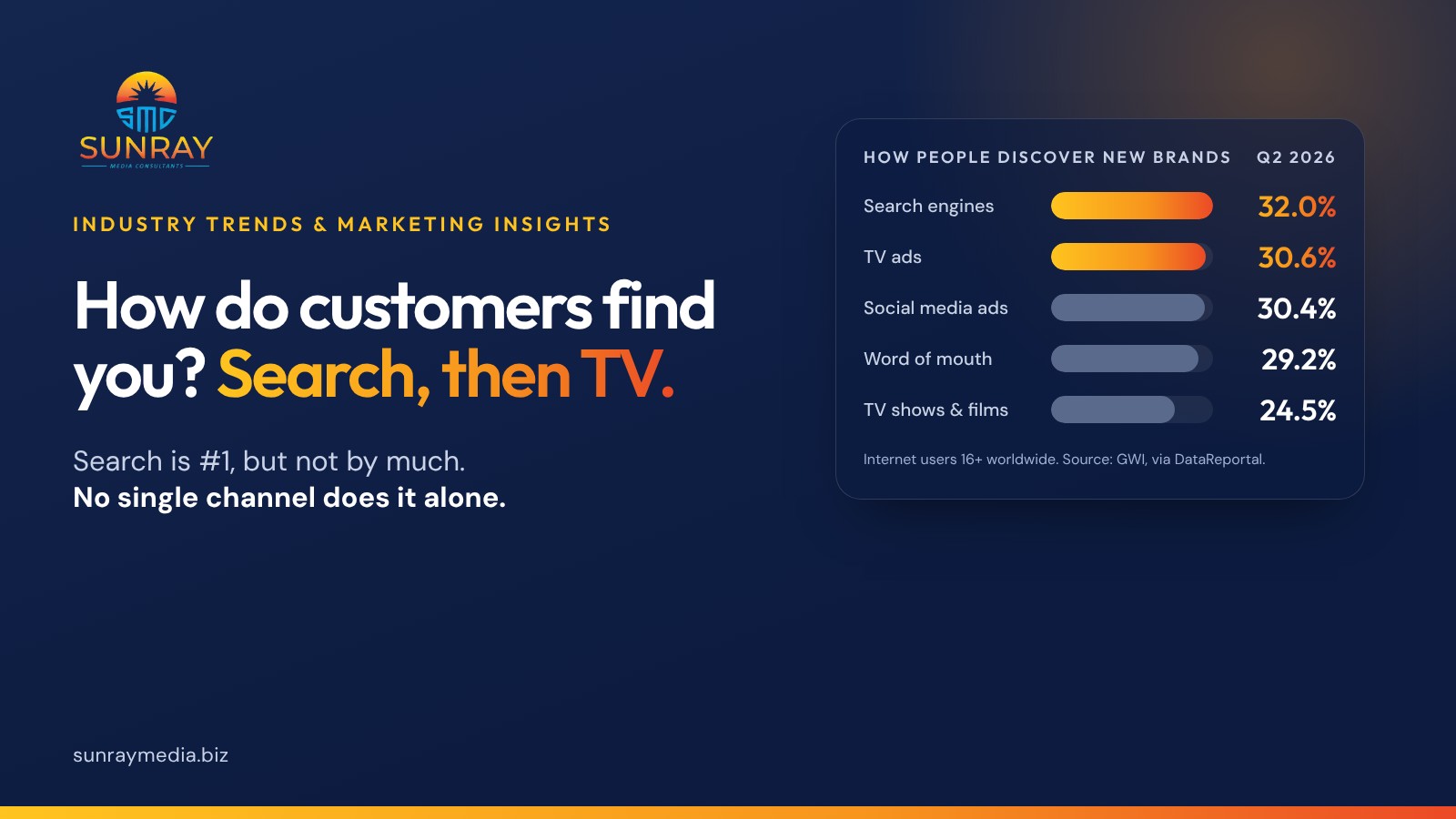
GWI asked internet users ages 16+ how they discover new brands, products and services. Here are the top channels, from its Q2 2026 survey of internet users worldwide, published in DataReportal’s October 2026 report:
- Search engines: 32.0%
- TV ads: 30.6%
- Social media ads: 30.4%
- Word of mouth: 29.2%
- TV shows and films: 24.5%
- Brand websites: 24.3%
- Social media comments: 22.9%
- Ads on websites and retail websites: 22.0% each
- Consumer review sites: 21.7%
Further down the list: ads in mobile apps and in-store promotions (20.8% each), online video and streaming TV pre-roll ads (18.5%), product comparison websites (17.7%) and AI assistants like ChatGPT (17.0%).
1.4 points
The gap between search engines (32.0%) and TV ads (30.6%) as the way people discover new brands. Social media ads are right behind at 30.4%. (GWI, Q2 2026)
Search is #1, but not by much
Search matters. When someone needs a dentist or a plumber, they Google it, and your Google Business Profile, reviews and website need to be ready. But search only works for people who already know they need something. Fewer than a third of people say search is how they discover new brands, so about two-thirds don’t list search at all.
The surprise at #2: TV
TV ads are the second-biggest discovery channel, just 1.4 points behind search and ahead of social media ads. Add TV shows and films (24.5%), and TV is part of how a big share of people first hear about a business. Discovery happens before the search: someone sees your commercial, remembers your name, and then searches for you when they need you.
That’s why TV and search work best together. Our posts on how to know your TV ads are working and why Americans stream more TV than anyone explain how TV and streaming fit together.
It depends on who you’re trying to reach
The top discovery channel changes with age:
- Ages 16–34: social media ads are #1 (33.4% for 16–24, 32.3% for 25–34), with search second.
- Ages 35–54: search engines are #1, with social media ads (35–44) or TV ads (45–54) close behind.
- Ages 55–64: TV ads are #1 at 36.1%, ahead of search at 35.4%.
- Ages 65+: TV ads are #1 at 47.6%, followed by word of mouth at 42.1%.
A pediatric dentist reaching young parents, a personal injury firm reaching working adults and an implant practice reaching people 55 and older each need a different mix.
After they discover you, they research you
Discovery is only the first step. In the U.S., 51.9% of internet users research brands, products and services online before buying, above the worldwide average of 48.0%. Worldwide, people use an average of 3.8 different channels when they research a brand. The top ones:
- Search engines: 45.3%
- Social networks: 41.8%
- Consumer reviews: 35.3%
- Product and brand websites: 32.9%
- Mobile apps: 30.6%
- AI tools like ChatGPT: 26.0%
Americans lean on search even more: 56.7% of U.S. internet users use search engines to research brands and potential purchases, well above the worldwide 45.3%. That’s branded search: someone who saw your commercial or heard about you from a friend types your name into Google to check you out. If your Google Business Profile, reviews and website aren’t ready when they do, the awareness you paid for leaks to a competitor.
Search is still king, but AI is moving in
Search engines are still the biggest research tool, but AI is starting to play a much bigger role in how people discover and choose brands. Already 18.5% of U.S. internet users use AI tools like ChatGPT to research potential purchases, and 17% of people worldwide say AI is how they discover new brands in the first place.
Younger buyers are leading the shift. Worldwide, about 30% of internet users ages 16 to 24 use AI for brand research (29.8% of women and 33.3% of men), compared with about 1 in 5 people ages 55 to 64. As those younger buyers start choosing dentists, lawyers and contractors, AI will matter more every year.
AI doesn’t show ten blue links. It gives an answer, and it builds that answer from what it can find about you online: your website, your reviews, your listings and what others say about you. Businesses that make that information clear and consistent are the ones AI recommends. Read more in our posts on how your business gets found in the age of AI and the world’s most-visited websites, where ChatGPT now ranks fifth.
Your website still closes the deal
Wherever people discover you, most of them end up on your website. 57.4% of U.S. internet users visited a brand’s website in the past month, compared with 42.7% worldwide. Worldwide, it’s the most common online brand interaction in every age group. Worldwide, people 65 and older are the most likely of all to visit (55.3% of women and 58.6% of men). A slow, outdated or confusing website undoes the work your advertising did to get them there.
No channel does it alone
The top four discovery channels (search, TV ads, social media ads and word of mouth) are within three points of each other, and no single channel reaches even a third of people. Then buyers check you out on nearly four more. The businesses that win show up across the whole path: seen on TV or social, remembered by name, found on search and AI, backed by reviews, and closed by a strong website.
A lot to keep track of. That’s where we come in.
For a small or mid-sized business owner, that’s a complicated media landscape: search, AI, TV, streaming, social, websites and reviews, each with its own reps, prices and rules. Sunray Media Consultants helps you navigate it. We figure out which channels reach your customers, build one plan across them, negotiate the media, produce the creative and report every month on what’s growing your brand and bringing in new sales. Read more about how we take marketing off your plate.
Book a free marketing diagnostic and we’ll show you where your customers are discovering businesses like yours, and how to make sure it’s yours they find.
Sources
- DataReportal, Digital 2026 October Global Statshot Report (We Are Social and Meltwater): “Sources of brand discovery,” “Online brand research,” “Main channels for online brand research,” “Brand research: average channels,” “Use of search engines for brand research,” “Use of AI tools for brand research,” “Online brand interactions” and “Visiting brand websites,” overall, by country and by age group, GWI data for internet users ages 16+, Q2 2026. datareportal.com. Data for ages 65+ is not yet available in all countries.