“If I run TV ads, how do I know they’re working?” It’s the question I’ve heard most in more than 20 years of buying television, and now streaming, for South Florida businesses. Usually it comes from an owner who is used to digital: clicks and impressions on a dashboard every morning. TV doesn’t show up that way. Neither does streaming, which is the new television. Here’s how both do show up, and how to measure them.
Why TV doesn’t look like a click
A search ad reaches someone who is already looking. A click is the receipt. TV works earlier than that. Most of your market isn’t shopping today; when they are, they call the name they already know. TV is how that name gets into their head before the need arrives, which is why the result shows up later, in a phone call or a walk-in, not in a click you can trace back to the spot.
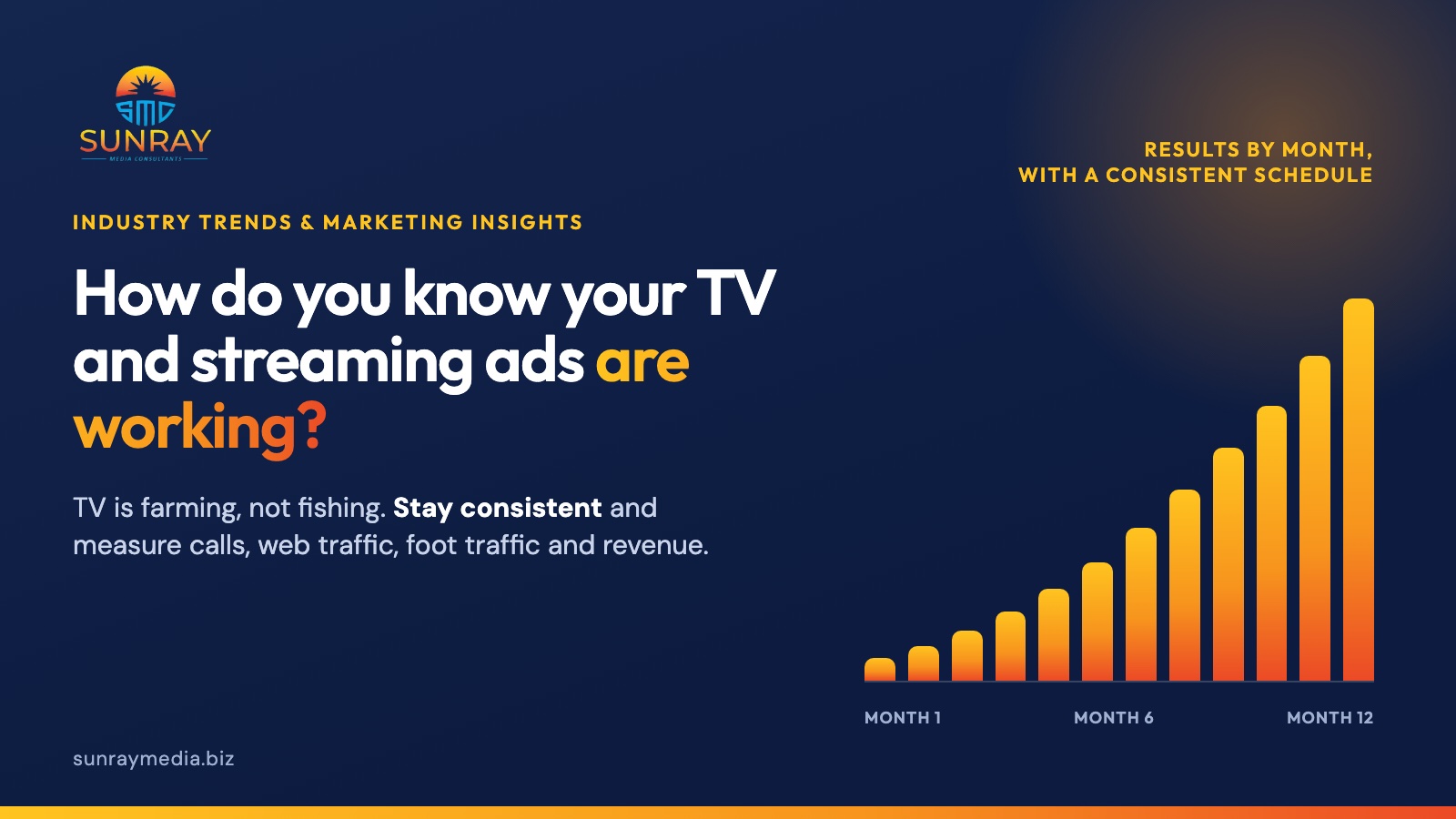
TV is farming, not fishing
Fishing is a search ad: cast where the fish are biting, pull one out, count it. TV is farming. You plant, you water, and for a while there is nothing to see. Then it grows, and it keeps producing for as long as you keep tending it. Try it once for a month and quit, and nothing comes up. That isn’t TV failing. It’s a field you stopped watering.
U.S. research says the same thing. Nielsen Catalina Solutions and CBS ran 31 studies on 23 American brands, tracking the households that saw the TV ads for a full year after the campaign. The sales the ads produced after the first 12 weeks were as large as, and often larger than, the sales they produced during them. In one Kellogg’s campaign, the long-term effect was 1.8 times the short-term sales, for 2.8 times the total return a short-term read would have shown.
A 2025 study by MMA Global and TransUnion, built on campaigns from Ally, Kroger and Campbell’s, found that short-term measurement undervalues brand advertising by as much as 83%, and that brand campaigns delivered 1.8 to 6 times the long-term sales impact of short-term tactics.
The cost of stopping is measurable too. Nielsen’s Compass data shows a brand loses 2% of future revenue for every quarter it doesn’t advertise, and Nielsen’s research found it takes three to five years of consistent brand building to recover from an extended time off air. The owner who “tried TV once” pays twice: once for the field that never grew, and again to start over.
Streaming is the new television, and the same rules apply
OTT streaming (Hulu, Peacock, Prime Video, Roku, Netflix with ads) is television delivered over the internet, watched on the same screen in the same living room. Nielsen’s monthly Gauge report now puts streaming at roughly half of all the time Americans spend with the TV screen. A 30-second spot inside a show builds the same memory whether it arrived by antenna, cable or Wi-Fi, and it decays the same way when you stop.
What streaming adds is control. You can run in your own ZIP codes, target households by what they watch and buy, and get impression reports by day and hour, which makes lining up calls and website visits with the schedule easier. Minimums are lower, so a local business can afford to be consistent. The trap is the same as digital: an impression count on a dashboard is not the result. The result is still the four numbers below.
What “working” looks like
The Video Advertising Bureau tracked 201 U.S. brands that ran TV for the first time between 2020 and 2024. Website traffic rose an average of 12% in the launch month and stayed about 20% above the pre-TV baseline through the campaign. People saw the spot, then went looking.
We see the same pattern with our own clients. One South Florida restaurant we work with paused its campaigns for two months: visits to its Call Now page fell about 99%, then climbed past the old level once the campaign resumed. The numbers are here. Blakeley Law Firm, a TV and streaming client, saw its practice grow in less than a year of consistent airtime. And when we renegotiated one client’s media buy, the same budget bought 6.6× the exposure; see how.
How to tell if your TV and streaming ads are working: measure four things
Consistency is the answer to the measurement question, because it gives you something to measure against. Set your baseline before the first spot airs, keep the schedule steady, and watch these four numbers month over month. We set this up for every Sunray client.
1. Phone calls
Call tracking with a dedicated number on the spot, plus one question at the front desk: “How did you hear about us?” We tag calls by source and by flight dates, so you see call volume rise and fall with the schedule, not with your gut feeling.
2. Website traffic
TV and streaming drive people to Google your name and to type your address. Watch direct visits and branded searches, not total traffic. We line them up against the days and hours the spots ran.
3. Foot traffic
For restaurants, retail and showrooms we track visits against the campaign calendar: door counts, point-of-sale transactions, a TV-only offer, or location data where it’s available. The pattern tells you whether more people are walking in, and when.
4. Revenue
Revenue is the result of activity. More people know you, so more people call, visit and buy. Compare campaign months with the same months last year and with the months before you started, and keep the view long enough for the farming to pay off. We review it with you every month and move money toward what’s producing.
Give it the time it needs
Commit to a schedule you can sustain, usually six to twelve months, rather than a big burst you can’t repeat. Keep the message and the look consistent, so each spot builds on the last. Review monthly: adjust the stations, the streaming platforms, the dayparts and the creative, but don’t go dark. The businesses that win on TV are the ones still on air when the competitor who “tried it once” has already quit.
What we do at Sunray
We buy TV and streaming as an independent agency, so we don’t sell inventory; we negotiate it. Before your first spot airs we set your baseline for calls, web, foot traffic and revenue. Then we plan a consistent schedule, produce the creative, place and negotiate the buy, and report the four numbers every month. If you’re already on air and can’t tell whether it’s working, book a free marketing diagnostic and we’ll show you what your schedule is producing and what to change.
Sources
- Nielsen, When it comes to long-term ad effectiveness, know your numbers: Nielsen Catalina Solutions and CBS, 31 studies, 23 U.S. packaged-goods brands.
- Nielsen, Beyond today: why long-term marketing drives business longevity (Nielsen Compass data, 2023).
- MMA Global and TransUnion, Brand as Performance: proving brand marketing drives long-term growth (October 2025; Ally, Kroger, Campbell’s).
- Nielsen, The Gauge, monthly share of U.S. TV-screen time by platform.
- Video Advertising Bureau, “Breaking Through,” 201 first-time TV advertisers, April 2020 to April 2024, as covered by Marketing Dive.
- Sunray Media Consultants client results: Marketing Impact Report: Local Restaurant #2 and the ad spend efficiency case study.