“How much should I budget for advertising?” It’s the question I hear most, and anyone who answers it with one number is guessing. The honest answer depends on your industry, your stage and your goal. But one part of it isn’t a judgment call: a consistent budget beats no budget every time, because not advertising is the most expensive option you have.
The benchmarks, and what they hide
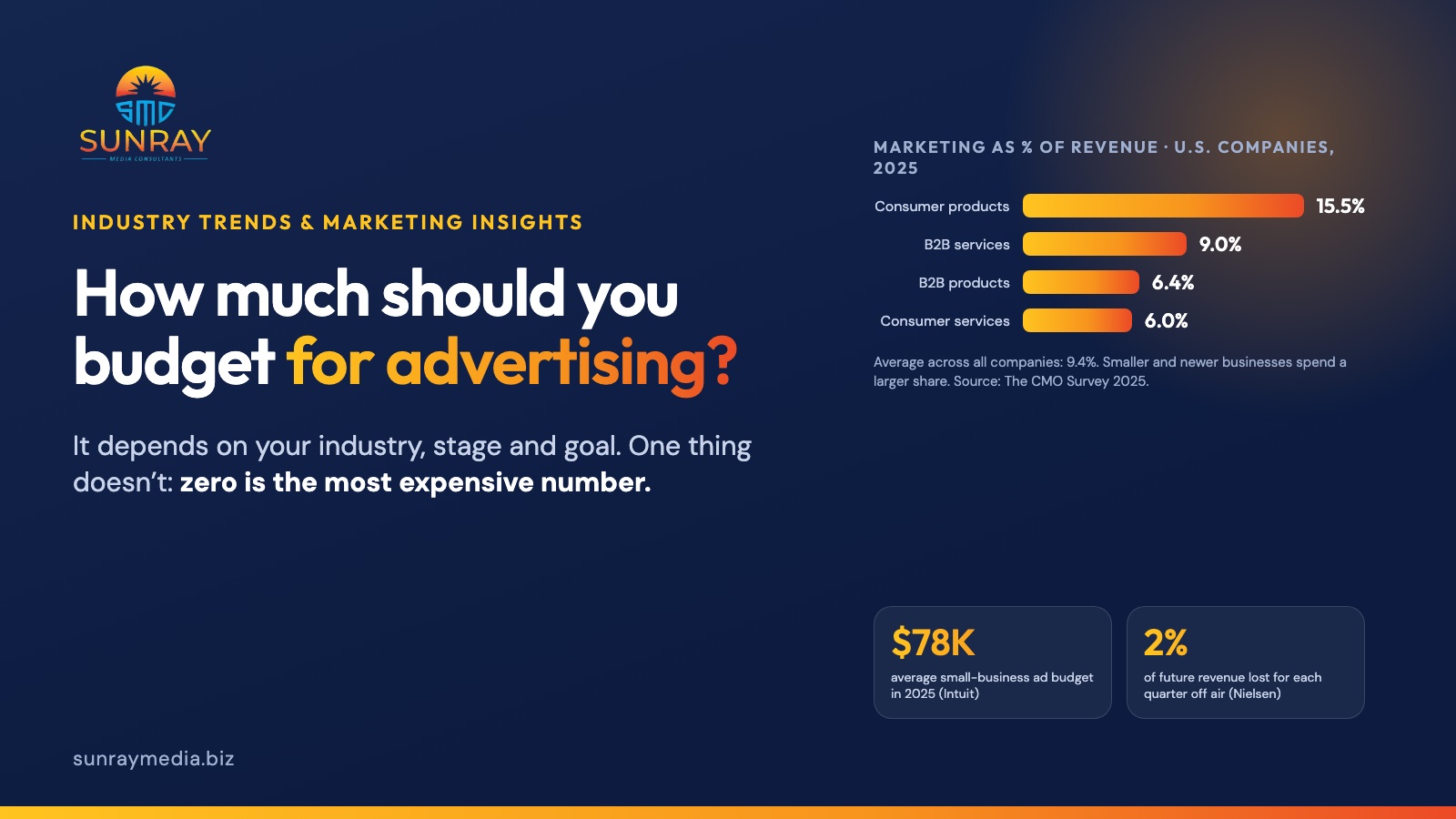
The CMO Survey, run by Duke University with Deloitte and the American Marketing Association, asks U.S. marketing leaders what they spend. In 2025, marketing averaged 9.4% of company revenue and 11.4% of total company budgets. The spread by business type is the real story: consumer product companies spend 15.5% of revenue, business-to-business services 9.0%, business-to-business products 6.4% and consumer services 6.0%. Smaller companies and companies that sell more online spend a larger share than big ones.
For small businesses specifically, Intuit’s 2025 survey of 1,006 U.S. owners and marketing leaders put the average advertising budget at about $78,000 a year, and 92% said they would hold or increase it; only 8% planned to cut.
You’ll also find a “7 to 8% of revenue” rule repeated across the internet, usually attributed to the Small Business Administration, never with a link to an SBA document. Treat it as a rule of thumb, not a prescription. A jeweler with a 50% margin and a restaurant with a 5% margin should not be spending the same share of sales.
Why there’s no single number
- Margins. The share of revenue you can put into growth depends on what’s left after you deliver.
- What a customer is worth. One personal injury case, one kitchen remodel and one lunch justify very different costs to win them.
- How crowded your market is. If three competitors are on TV and radio every week, being heard costs more than it does in a quiet category.
- Your goal. Defending what you have, growing 20%, or opening a second location are three different budgets.
Stage changes the math
A new business starts with awareness near zero. Nobody in the market knows the name, so the first job is to buy share of voice, and it has to be bought at a rate above the share of market you hold, because that gap is what grows a brand. Nielsen’s research puts it in numbers: ten points of share of voice above share of market produces about half a point of market share growth within a year. As a percentage of a young company’s revenue, that launch budget is large, often several times the industry average, because the revenue is small and the awareness has to be built from nothing.
A mature business is in a different place. The name is known, the memory is built, and the job is to keep it refreshed and defend it against the newcomers. That takes a steadier, smaller share of revenue, but it never drops to zero, because memory fades the moment you stop feeding it.
The most expensive budget is zero
Nielsen’s Compass data shows a brand loses about 2% of future revenue for every quarter it doesn’t advertise, and that it takes three to five years of consistent brand building to recover from an extended time off air. We’ve watched it happen locally: one South Florida restaurant paused its campaigns for two months and visits to its Call Now page fell about 99%. That case is here.
The reason is simple. Most of your market isn’t buying today. When they are, they call the name they remember, and if you went quiet, the name they remember is your competitor’s. Every month you don’t advertise, you aren’t saving money. You’re paying for your competitor’s customer.
How we set a budget with you
We don’t start with a percentage. We start with a conversation and the numbers, in the free diagnostic:
- Where you are. What you spend today, what it buys, and how aware the market is of you.
- Where you want to be. The calls, visits and revenue you need, and by when.
- Your stage and your margins. Launch, growth or defend; what a customer is worth; what you can sustain.
- The cost to reach your market consistently. The channels your customers actually use, priced at negotiated rates, not rate-card rates. We took one client from $100 to $15 per thousand impressions on the same budget; see how.
Then we recommend a number you can keep for twelve months, because a budget you can sustain beats a bigger one you abandon in month three. We review calls, website traffic, foot traffic and revenue with you every month and move money toward what’s producing.
What to do with the question
Don’t answer it with a rule of thumb. Answer it with your margins, your goal, your stage and a consistent plan. If you want help working it out, book a free marketing diagnostic. You’ll leave with a number, the reasoning behind it, and a plan for what it should buy.
Sources
- The CMO Survey, Highlights and Insights Report, 2025 (Duke University, Deloitte and the American Marketing Association; U.S. marketing leaders).
- Intuit SMB MediaLabs, Small Business Advertising Trends 2025 (1,006 U.S. business owners and marketing leaders, March 2025).
- Nielsen, Beyond today: why long-term marketing drives business longevity (2023).
- Sunray Media Consultants client results: Marketing Impact Report: Local Restaurant #2 and the ad spend efficiency case study.