“Should I stop advertising until the economy turns around?” It’s the first question business owners ask when sales slow down, and the answer surprises most of them: do the opposite. A downturn is the best time to increase your advertising and stay consistent, because it’s the cheapest time to take market share from competitors who go quiet.
Why cutting feels right, and why it backfires
When revenue tightens, advertising looks like the easiest line to cut. It doesn’t show up as a missing employee or an empty shelf. But your customers don’t stop needing a lawyer, a new roof or a good dinner because the headlines are bad. They get more careful about who they choose, and they choose the name they know and trust. If you went silent, that name belongs to someone else.
Going dark also costs more than the months you’re off air. A study of 365 U.S. brands in 22 consumer categories, published in the Journal of Advertising Research, found that brands that stopped advertising lost market share steadily, year after year, with double-digit losses common after the first year. Smaller brands were hit hardest. Once share is lost, it is expensive to win back.
Reason one: your competitors are leaving the room
In a downturn, most businesses cut their budgets. That leaves more open share of the conversation. Marketers call it share of voice: your portion of all the advertising in your category. When competitors go quiet, every dollar you spend is a bigger slice of what customers see and hear.
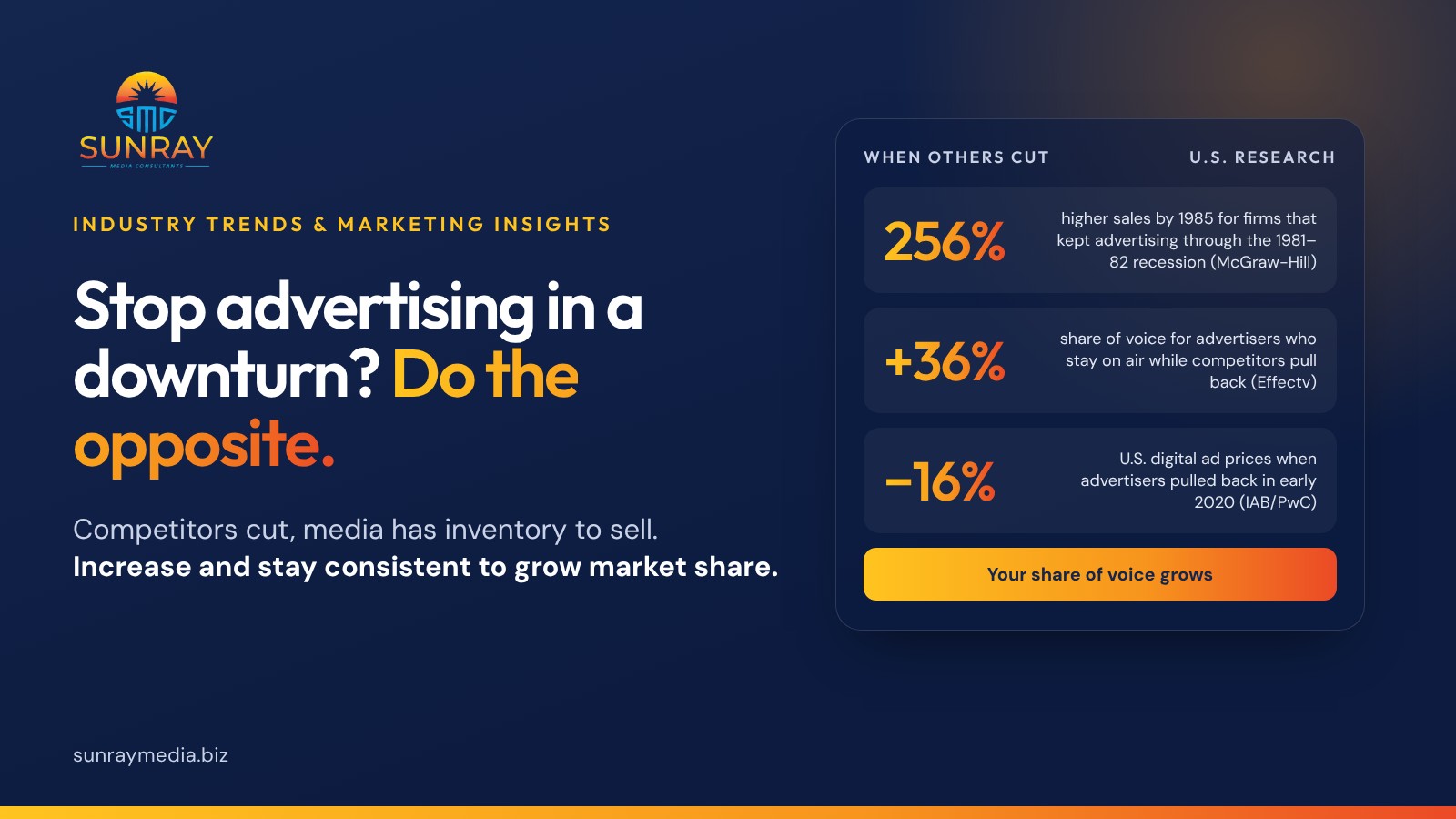
Share of voice matters because it leads share of market. Research from Effectv, Comcast’s advertising division, shows how fast the gap opens: when competitors pull back during the slower summer months, advertisers who stay on air increase their share of voice by 36% on average. The same research found market share accelerates for brands that keep advertising while competitors stop, and declines quickly for any brand that goes quiet. A downturn creates that same opening, only bigger and longer.
Reason two: the media has more inventory to sell
When fewer businesses advertise, TV stations, radio stations, streaming platforms and websites have more unsold commercial time and ad space. Unsold inventory is lost revenue for them, so prices soften and there’s more room to negotiate. In early 2020, when advertisers pulled back, IAB and PwC reported U.S. digital ad prices down about 16%, with display rates down more than 30%.
That means the same budget buys more reach, better placements and more frequency than it would in a crowded market. We negotiate on every buy for our clients, and a downturn is when that negotiating power is strongest.
U.S. research has said this for 40 years
- The 1981–82 recession. McGraw-Hill Research followed 600 business-to-business companies from 1980 to 1985. Companies that kept or increased advertising during the recession had sales 256% higher by 1985 than those that cut back.
- 2020. When advertisers pulled back at the start of the pandemic, U.S. digital ad prices fell about 16%, so the businesses that kept going bought more reach for less.
- Brands that go dark. The 365 U.S. brands that stopped advertising lost share every year they stayed off air.
The pattern holds across decades, industries and types of media in the U.S.: the businesses that stay visible when others disappear come out of the downturn bigger.
What we recommend at Sunray
At Sunray Media Consultants, we recommend that a downturn is the time to increase your advertising and be consistent. That doesn’t mean spending recklessly. It means spending smart:
- Increase, don’t pause. Even a modest increase is a big gain in share of voice when competitors are cutting.
- Stay consistent. Pick a level you can sustain for twelve months. On-again, off-again advertising wastes the memory you’ve already paid to build. We’ve seen one South Florida restaurant pause its campaigns for two months and lose about 99% of visits to its Call Now page; that case is here.
- Negotiate harder. Use the extra inventory in the market to buy more for the same money. We took one client from $100 to $15 per thousand impressions on the same budget; see how.
- Measure everything. Track calls, website visits, foot traffic and sales every month, and move money toward what’s producing.
Not sure what number is right for you? Our guide on how much to budget for advertising walks through it.
The bottom line
A downturn doesn’t shrink the market forever. It reshuffles it. When the economy recovers, the businesses customers remember are the ones that kept showing up. If you want a plan to grow your market share while others pull back, book a free marketing diagnostic.
Sources
- McGraw-Hill Research, Laboratory of Advertising Performance study of 600 business-to-business companies, 1980–1985 (as reported in MarketingProfs, 2008).
- “When brands go dark,” Journal of Advertising Research, 2023 (market share of 365 U.S. brands in 22 consumer goods categories after they stopped advertising), as reported by WARC.
- Effectv (Comcast), Summer advertising increases share of voice.
- IAB and PwC, U.S. digital ad revenue data for Q1 2020, as reported by WARC.
- Sunray Media Consultants client results: Marketing Impact Report: Local Restaurant #2 and the ad spend efficiency case study.