Some people call it terrestrial radio. I call it the medium that rides to work with your customers. Local radio reaches more Americans every month than any other platform, it owns the car, and it comes with something no app has: a local voice people already trust. Here are the numbers, and how a South Florida business uses them.
Radio still reaches almost everyone
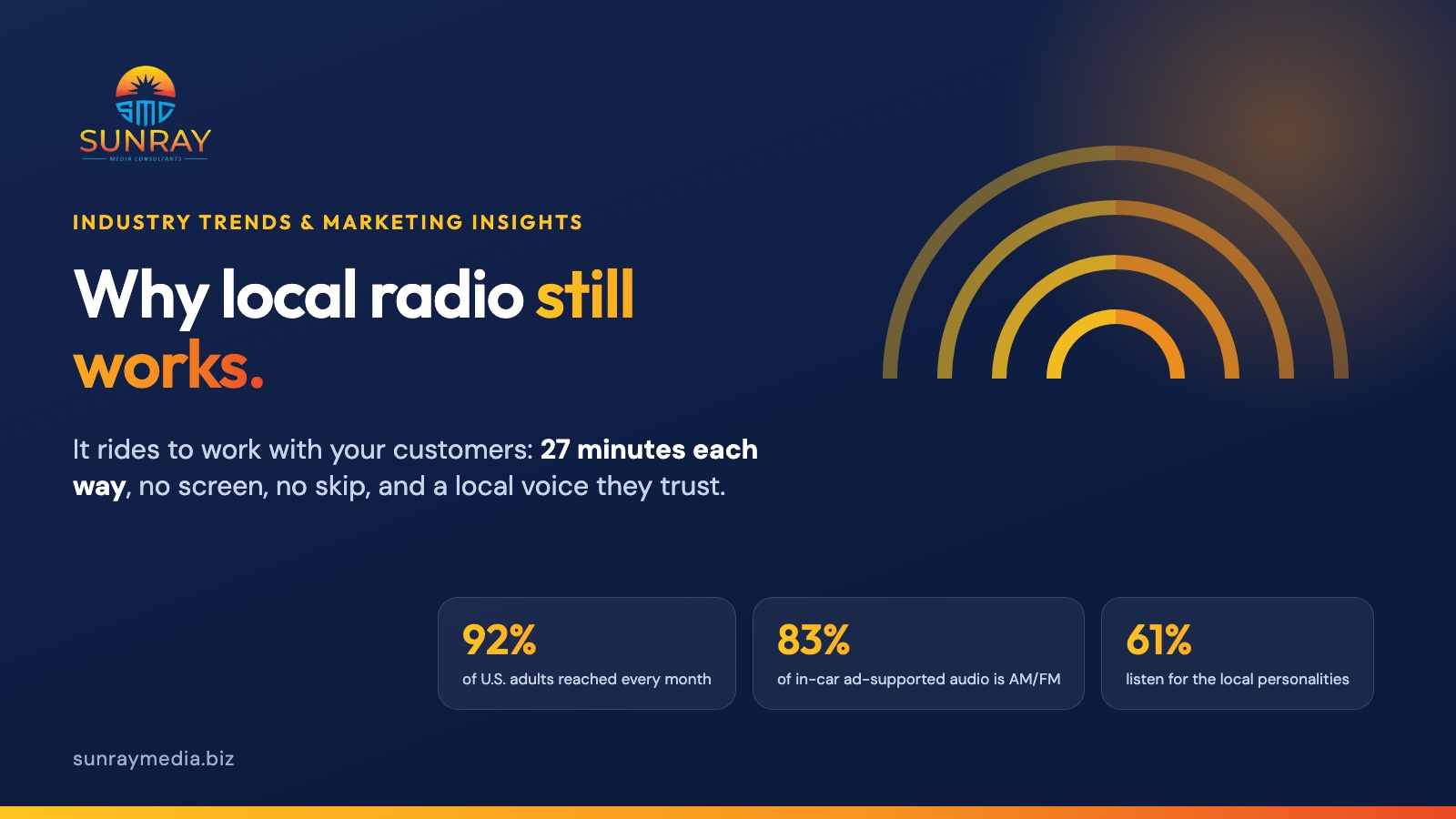
Over-the-air radio reaches 92% of U.S. adults every month, the highest monthly reach of any media platform in the country, ahead of live TV, streaming and mobile, according to Nielsen’s 2025 Comparable Metrics report. Americans spend nearly four hours a day with audio, and 82% of the ad-supported part of that time goes to AM/FM radio and podcasts.
That is not a niche audience. It is your customers, your employees and your competitors’ customers, every day.
The car: 27 minutes each way that nothing else can reach
Most of your market drives to work. Census data puts 78% of American commuters in a car, truck or van, 88% of them alone, with an average one-way commute of about 27 minutes. That is close to an hour a day with no screen to scroll, no feed to skip, and one dashboard button that has been there since the car was built.
Edison Research’s Share of Ear study for late 2025 shows what happens in that hour: AM/FM radio accounts for 83% of all ad-supported audio listening in the car among adults, a share that has barely moved in a decade. Counting ad-free listening too, radio still holds 54% of all in-car audio. And the car has become radio’s main room: 53% of all AM/FM listening now happens there, up from 42% in 2015, and 63% among adults 18 to 34.
Think about who is in that car. The homeowner driving past the sign for the AC company. The office worker deciding where to get lunch. The couple on the way to look at a ring. They are alone, they are going somewhere, and they are about to spend money. A spot in morning or afternoon drive puts your name in that moment, every single day.
Local DJs: the voice they already trust
Jacobs Media’s Techsurvey 2025, which asked about 24,500 listeners of 500 stations why they tune in, found that for the seventh year in a row the top reason is the personalities, cited by 61%, ahead of the music at 56%. More than half, 56%, say they feel a connection to their local stations that they don’t feel with any other audio.
That connection is for rent. When a host your customers wake up with reads your spot or tells a story about your business, you borrow a trust no 30-second voiceover can buy. Stations also live in the community: remotes, charity drives, high school sports, the chamber breakfast. Sponsor the right one and you are not just on the air, you are in the room.
Radio builds a brand the way TV does
Radio works like television: it plants your name before the need arrives, and it pays off with consistency. A commuter hears your spot five mornings a week, week after week. Nobody can do that with a flyer, and no search ad reaches them before they search. If you read our post on how to know your TV and streaming ads are working, every word of it applies here: farming, not fishing.
The return is real. In Nielsen’s sales-effect study of U.S. retail advertisers, every dollar spent on radio returned $17 in sales for department stores, $16.37 for mass merchandisers, $9.48 for home improvement retailers and $3.01 for quick-service restaurants. Results vary by category and creative, and that study dates to 2016, but it is the same lesson our clients see: reach the whole market often enough and the register moves.
How to use local radio well
- Buy frequency, not a one-week blast. Morning and afternoon drive, several days a week, for months. Radio rewards the advertiser who is still there in week twelve.
- Write for the ear. One message, your name said at least three times, and one reason to call now. If the listener is driving, the phone number is your website name, not seven digits.
- Use the host. Live reads and endorsements outperform produced spots when the personality fits your customer.
- Speak the market’s language. In South Florida that means Spanish-language radio alongside English, often with the same offer and a different story.
- Measure the four numbers. Calls, website traffic, foot traffic and revenue, lined up against the flight dates. We set that up before the first spot airs.
- Pair it with the screen. Radio in the car, TV and streaming at home. The same name in both places compounds faster than either alone.
What we do at Sunray
We have bought South Florida radio for more than 20 years as an independent agency. We don’t sell airtime; we negotiate it, station by station, and we place your budget in the dayparts where your customers are actually driving. We produce the spots in English and Spanish, manage the campaign, and report the four numbers every month. Blakeley Law Firm’s radio campaigns across Broward and Miami-Dade are one example of that work. If you want to know what radio could do for your business, or whether the schedule you’re running is the right one, book a free marketing diagnostic.
Sources
- Nielsen, Q2 2025 Comparable Metrics report, as reported by Radio Ink (October 2025).
- Nielsen and Edison Research, The Record: Q1 U.S. audio listening trends (June 2026).
- Edison Research, Share of Ear, Q4 2025, analysis by Westwood One Audio Active Group, as reported by Radio Ink (March 2026); includes U.S. Census commuting data.
- U.S. Census Bureau, American Community Survey 2023, mean travel time to work, as summarized by the National Conference of State Legislatures.
- Jacobs Media, Techsurvey 2025, as reported by Radio Ink.
- Nielsen, radio sales-effect study of retail advertisers (2016), as reported by MediaPost.