Local fans don’t watch their team. They follow it, religiously, every game, every week, for the whole season. For a business that needs to be seen, that loyalty is the most valuable thing in media: the same people, in front of the same screen or the same radio, over and over. That’s why sports is king. And it’s why your 30-second commercial belongs in the game, on TV, on streaming and on the radio call.
Sports owns the biggest audiences left on television
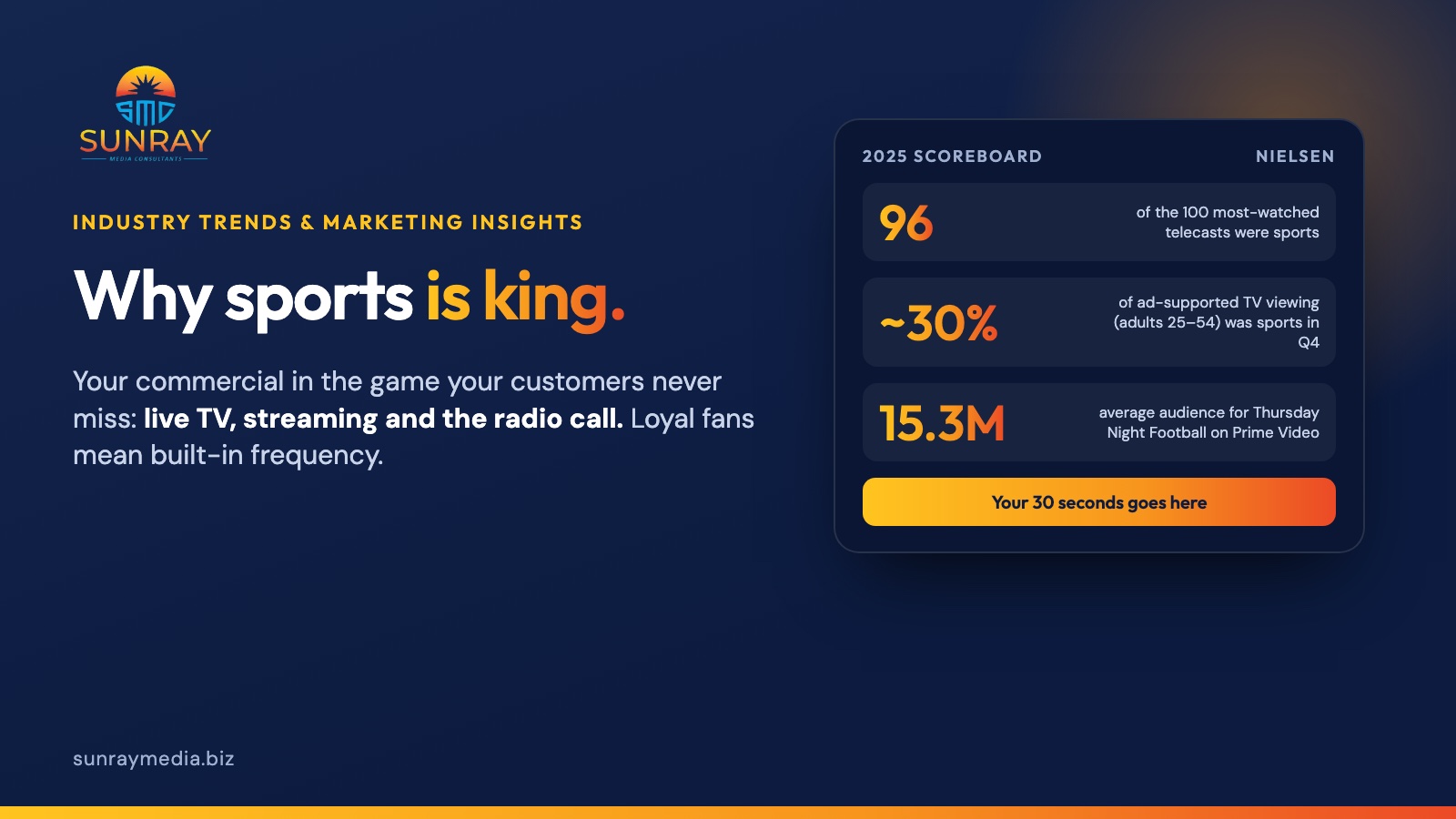
Of the 100 most-watched telecasts in the United States in 2025, 96 were sports, according to Nielsen. The NFL alone averaged 18.7 million viewers a game in the 2025 regular season, its second-best ever. Nielsen’s Ad-Supported Gauge for the fourth quarter of 2025 shows sports accounted for nearly 30% of all ad-supported TV viewing among adults 25 to 54, while broadcast programming without sports was just 9.8%.
Put plainly: when a South Florida household gathers in front of a screen with the ads left in, odds are it’s for a game.
Fans watch live, with the sound on
Nobody records the game and watches it Tuesday. Sports is the last appointment television: live, in real time, often with friends, and with the commercials playing because the break is part of the ritual. There’s no skip button on a timeout. Your spot runs to a room that chose to be there.
Frequency comes free with loyalty
A Dolphins fan sees 17 regular-season games. A Heat or Panthers fan, 82. A Marlins fan, 162. The schedule is a frequency plan built by the league. The same fans show up for every one of those games, so a business that runs in the broadcast all season isn’t reaching new people every week; it’s reaching the same people again and again until the name sticks. That is exactly how brand recognition is built, and sports delivers it on a calendar.
The passion is local and measurable. Game 7 of the 2024 Stanley Cup Final drew a 9.6 rating in the Miami–Fort Lauderdale market, roughly one in ten TV homes watching the Panthers lift the Cup at the same moment.
Streaming brought sports to every budget
Thursday Night Football on Prime Video averaged 15.3 million viewers in 2025, its most-watched season, and NFL games now land on Netflix, Peacock and YouTube as well. For a local business this is the real change: streaming sports can be bought by ZIP code and household, so a Tamarac AC company can run inside a national game and pay only for the homes it serves. Sunray is an Amazon partner for Prime Video and places the same campaigns across the other streaming platforms.
And on the radio
The game doesn’t stop in the car. AM/FM radio carries 83% of the ad-supported audio people hear while driving, and the play-by-play call, the pre-game and the post-game show are where fans go when they can’t be in front of a screen: on the job site, in the truck, on the drive home. A 30-second audio spot inside the broadcast reaches the same loyal audience at the moments TV can’t. If you want the full case for radio, it’s here.
Buy it wrong and it gets expensive
Sports is the most valuable airtime a station or platform sells, and it’s sold accordingly: season packages, premium units, ratings claims and a rep who needs to move inventory before the season starts. Three mistakes cost local businesses the most.
- Paying for the wrong audience. A team your customers don’t follow, a game that airs opposite one they do, or a national rate for a local audience.
- Paying for prestige instead of people. A single marquee game with a big number next to it often delivers fewer people per dollar than a season of regular games.
- Taking the package as offered. The first proposal is a starting point. It is rarely the best cost per thousand you can get.
This is where we earn our keep. Before you spend, we pull the per-game audience data for every team and station in the market, calculate the cost per thousand of every unit in the proposal, strip out the one-off specials that inflate the average, compare the options and negotiate. We don’t sell airtime, so the recommendation is about your customers, not someone’s inventory. The same discipline took one client from $100 to $15 per thousand impressions on the same budget; here’s that case.
How to run your commercial in sports the right way
- Pick the team your customers watch. Not the one with the biggest headline number. Match the audience to the people who buy from you.
- Buy the season, not the game. Frequency is the point. A consistent schedule across the season beats one expensive splash, the same way it does everywhere else on TV.
- Make a spot that belongs in the break. Fast, local, your name three times, one reason to call, produced for the screen and cut for radio.
- Measure the four numbers. Calls, website traffic, foot traffic and revenue against the game schedule, so next season’s buy is built on what this season produced.
What we do at Sunray
We produce the commercial, buy the games on TV, streaming and radio as an independent agency, negotiate every rate against the audience data, and report what it brings in. If a rep has a sports proposal on your desk, send it over before you sign: book a free marketing diagnostic and we’ll tell you what the package is actually worth and how to buy it better.
Sources
- Nielsen year-end telecast rankings, as reported by Barrett Media (December 2025) and the Boston Globe (January 2026).
- Nielsen, Q4 2025 Ad-Supported Gauge, as reported by Marketing Dive.
- Nielsen, Thursday Night Football 2025 season, as reported by Sports Media Watch.
- Miami–Fort Lauderdale local rating for the 2024 Stanley Cup Final, Miami Herald figures as reported by Barrett Media (June 2025).
- Edison Research, Share of Ear, Q4 2025, in-car ad-supported audio, as reported by Radio Ink.
- Sunray Media Consultants, ad spend efficiency case study.